

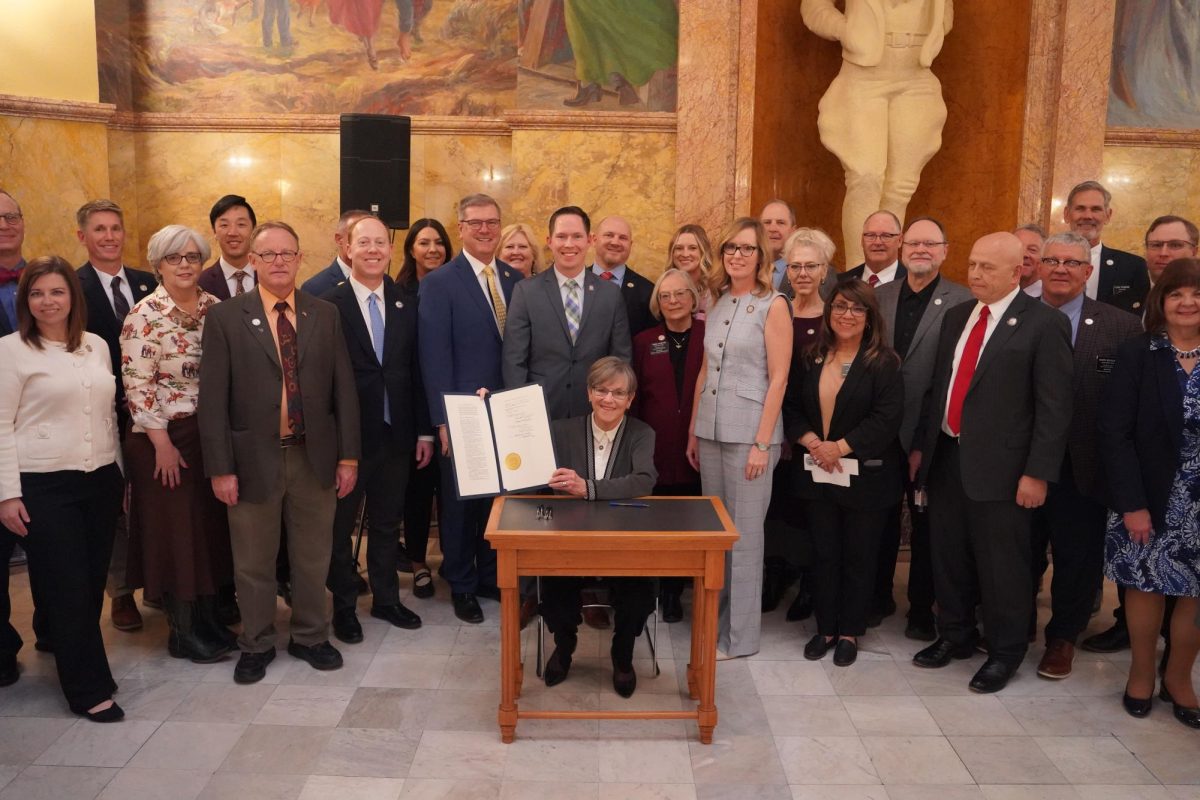
The Kansas legislature passed a bill, which Governor Laura Kelly signed into law March 19. The bill aims to reduce distractions during school, improve academic performance and boost student mental health.
Substitute for House Bill 2299 prohibits students from using personal electronic devices during school hours, and will be effective Sept. 1.
“In our rapidly changing world, technology dominates our lives, and that’s why it’s essential that we reduce distractions in the classroom,” Kelly said in an official statement. “We must have one uniform standard across the state to tackle this issue and set our students up for success.”
The bill is a bipartisan effort, with both Democrats and Republicans seeing common ground for students’ well-being.
“Research has shown us that our students’ mental health, test scores and concentration levels are negatively impacted by overuse of social media and cell phones,” Senate Democratic leader Dinah Sykes said in an official statement.
Representative Angela Martinez (D) in an official statement, lays out the underlying goal of the bill.
“This is about creating a school environment where kids can focus on learning, protect their mental health, and simply be kids again,” Martinez said.
Despite optimism among government officials, students have expressed worry about the bill. Sophomore Abigail Mercer recognizes potential communication issues students will face.
“During my college application, I needed my mom to send me important stuff, and without my phone, I wouldn’t be able to get that important information,” Mercer said. “I’d be stuck being unable to complete my application.”
According to the bill, students will be able to use school phones to contact parents during emergencies, though Mercer sees a potential flaw.
“Going to the office to contact parents might be too much of a hassle,” Mercer said. “There might be multiple people trying to contact their family at once, and having the students use their individual phones to do that lessens a lot of overload in the office.”
Concerns of mental health among students who may use technology to communicate or socialize has arisen among students. Students will now communicate through physical interaction, including during lunch or passing periods.
While students may dislike the idea, librarian Megan Vittitow highlights the potential benefits of students’ schoolwork.
“I think not being distracted during class will be a benefit,” Vittitow said. “I think there’s a study out there. It takes 10-15 minutes to get back on task once you’ve looked at your cell phone; so having more time on a task will be beneficial to students and staff.”
Vittitow also highlights a potential improvement in in-person student interactions.
“You’ll see students interact more in lunch rooms and during passive periods, instead of being on their devices all the time,” Vittitow said.
Vittitow expresses concern that the law has a few hiccups.
“I am a little hesitant of students that are enrolled in dual credit classes, seniors that have off block classes or students that are taking online classes because they use cell phones in the library, or they bring their own personal device for some of those classes,” Vittitow said. “That’ll be a little bit of a learning curve”
While the law does not allow personal electronic devices, there is no mention of prohibiting students’ personal emails, which, senior Aaron Hubbard thinks this may allow for potential loopholes.
“The network here at the school uses the same login as you would on any of the Windows computers,” Hubbard said. “You can just connect to internet that has slightly less firewall stuff; If you’re on an email that isn’t the school email, you don’t have to deal with the forced installed plugins that has blocked websites.”
Hubbard suspects students will find creative solutions around the phone ban using their school-issued Chromebooks.
“There’s always things you can’t even fix as an IT person; you cannot cover every single base,” Hubbard said. “There currently are ways around stuff, even if they do start blocking phones, there currently are a bunch of ways to go around it, and they haven’t done anything to circumvent it.”
While students may be wary of the new law, government officials and teachers alike have a positive outlook.
“Passing a bill is not the finish line. It’s the starting point. Our commitment moving forward is to partner with schools, to listen, to adjust where needed, and to make sure this policy works not just on paper, but in real classrooms, with real students,” representative Jason Goetz (R) said.